

Pairing Japanese Wine and Japanese Food: Our Picks and 4 Recipes
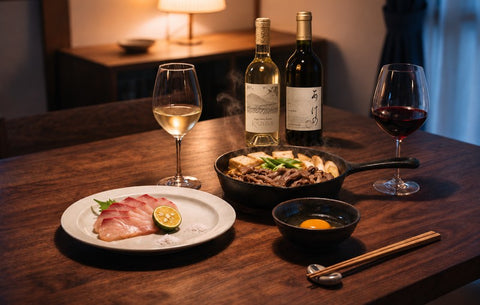
Table of contents
Introduction
When we put Japanese Wine Co. together, the line we wrote into our brand book was "Beautiful alone. Unforgettable with food."
I still think that's the best way to describe these wines.
A glass of Koshu (甲州) on its own is lovely, but it's a quiet wine, and it really wakes up when there's a plate of sashimi or a bowl of something in dashi next to it.
So this article is about the food side.
Which Japanese dishes go with which of our wines, and why.
If you've looked at any of our wine pages, you may have noticed a FAQ near the bottom, and one of the questions on every page is "What food does this wine pair well with?" Those answers are our own picks, based on how each wine tastes to us, and I've gathered all of them here in one place for the wines we carry so far.
For each wine, one dish on its list also has a photo on the product page. I wrote up a full recipe for each of those four dishes, and you can download all four as printable recipe cards further down.
Why Japanese Wine Works So Well With Japanese Food
Japanese cooking leans on umami (旨味), salt and a lot of restraint. Think dashi, soy sauce, miso, or a piece of grilled fish with nothing on it but salt. The flavors go deep, but they're rarely heavy.
Many of the world's famous wines grew up around other food, like butter and cream sauces, roast meat and tomato. Big oak and high alcohol can flatten a slice of white fish or a clear broth, and in my experience that's where most wine and Japanese food pairings go wrong.
Koshu grew up next to Japanese food, more or less. The grape has been in Yamanashi for something like a thousand years (I wrote about that in The History of Japanese Wine), and the dry style most of us drink today was worked out by Japanese winemakers, starting with Mercian's first sur lie Koshu in 1983.

Vineyards in Katsunuma, looking out over the Kofu basin in Yamanashi
So it isn't a big surprise that the wine ended up light, dry and fairly quiet on the nose, at around 12% ABV (both of our Koshu wines are exactly 12%). I think that restraint is exactly why it works, since the fish or the dashi gets to stay in front and the wine adds a bit of citrus and a clean, slightly salty finish behind it.

The Fishy Aftertaste Problem
Have you ever had a glass of red wine with sushi and noticed a strange, metallic, fishy taste afterward? There's actually research on that, and it came from a Japanese wine company.
Back in 2009, a team at Mercian tasted 38 red wines and 26 white wines alongside dried scallops and then measured what was in each wine. The fishy aftertaste lined up with how much iron the wine had in it (ferrous iron, specifically), and it got weaker when they added something that binds the iron.

Château Mercian in Yamanashi, the winery behind the 2009 study
I don't want to oversell one study with a small tasting panel. But it does fit the old advice to keep raw seafood with crisp whites, and it's a big part of why our picks put sashimi and crab with Koshu rather than with a Cabernet.
What About Red Wine?
Reds have a place at the Japanese table too, and two of our four wines are red. They just suit a different side of Japanese food.
One side is yōshoku (洋食), the Western-style dishes Japan made its own over the last 150 years, like hambāgu, omurice (my personal favorite!) and beef stew. The other is the sweet-soy beef dishes, like sukiyaki and yakiniku. Both have sweetness, fat and a lot of savory depth, which is what a red with some fruit and soft tannins likes, and you'll see that in the picks for Akeno and the Kazumi Cabernet below.

If you like omurice, check out Sony's 1/2 (Nibun no Ichi) in Ginza, Tokyo. It's the best omurice I've ever had, and the best yōshoku I've found Check out the story I wrote about this restaurant here. They have excellent wine selections.
Our Pairing Notes Live in Each Wine's FAQ
A quick note on where these lists come from before we get into them.
Every wine we carry has a FAQ on its product page, and each one includes a question like "What food does Grace Koshu pair well with?" We tried to be specific in those answers, so instead of just "sushi" you'll see an actual dish with its preparation, plus its name in Japanese so you can order it at a restaurant or search for a recipe. (or download below!)

We also gave each wine its own dishes. Four lists that all said sashimi wouldn't have helped anybody!
The lists below go from the lightest wine to the biggest. If you'd like to see them in their original home, they're on the pages for Grace Koshu, Kazumi Napa Valley Koshu, Akeno and the Kazumi Napa Valley Cabernet Sauvignon.
Grace Koshu (グレイス甲州) Pairings
Grace Koshu comes from Katsunuma in Yamanashi, Koshu's historic home, and it's made entirely in stainless steel with no oak at all. It won Platinum at the Decanter World Wine Awards in both 2015 and 2016, the first-ever Decanter Platinum from Japan. (If you want the whole story of the winery, I wrote a long article about Grace Wine.)

Grace Wine's winery in Katsunuma, Yamanashi
It's the more delicate of our two Koshu wines, with soft white peach, a little citrus, a gentle umami and a faintly bitter finish. Our picks lean into that last part with dishes that have a little bitterness of their own.

Koshu grapes in Yamanashi, each bunch under a small paper umbrella to keep the rain off
- Salt-grilled young ayu (稚鮎の塩焼き). Young sweetfish has a delicate bittersweet finish that mirrors the wine's own.
- Snow crab and chrysanthemum greens steeped in dashi (ずわい蟹と春菊のお浸し). Sweet crab and faintly bitter greens, pulled together by the wine's minerality.
- Amadai grilled Wakasa-style (甘鯛の若狭焼き). Crisp scales and soft white flesh, framed by the wine's lively acidity.
- Burrata with white peach and good olive oil (ブラータと白桃、オリーブオイル). The unexpected one, where the wine's acacia and white peach notes echo the plate.
Serve it well chilled, around 7 to 10 °C (45 to 50 °F).
The dish with the photo is the ohitashi, so that's the recipe I wrote up. Ohitashi (お浸し) just means greens soaked in a seasoned dashi, and it's one of the most everyday side dishes in Japanese home cooking. Adding snow crab turns it into something you'd happily serve to guests.
Chrysanthemum greens, or shungiku (春菊), are a winter vegetable in Japan (they're a classic in hot pots), so this is a good one to make right now. Most Japanese and Korean markets carry them.

Recipe: Snow Crab and Shungiku Ohitashi
Serves 2 to 4 as a small dish · Prep 15 min · Chill 30 min
Ingredients
For the dashi (hitashi-ji 浸し地)
- 240 ml (1 cup) dashi
- 1 tbsp (15 ml) usukuchi (light-colored) soy sauce
- 1 tbsp (15 ml) mirin
- A small pinch of salt
For the greens and crab
- 1 bunch shungiku (春菊, chrysanthemum greens), about 200 g (7 oz)
- 100 g (3.5 oz) cooked snow crab meat, leg pieces if you can get them
- Salt, for the blanching water
- Yuzu zest or an edible flower, to finish (optional)
Steps
- Put the dashi, soy sauce, mirin and salt in a small pan and bring it just to a boil so the mirin loses its alcohol. Let it cool, then chill it.
- Wash the shungiku well and trim off any tough stem ends. Bring a large pot of salted water to a boil and fill a bowl with ice water.
- Hold the bunch by the leaves and dip the stems in first for about 15 seconds, then push the leaves under for another 20 seconds or so. Move everything straight into the ice water so it stays bright green.
- Squeeze out the water firmly but gently, line the stems up, and cut into 4 cm (1.5 in) lengths.
- Lay the greens in a shallow dish, pour about two thirds of the cold dashi over them, and chill for at least 30 minutes (a few hours is fine too).
- Pick through the crab for bits of shell and cartilage, and pull the leg meat into long pieces.
- Lift the greens out, squeeze lightly, and mound them in a shallow bowl. Lay the crab on top, spoon the rest of the fresh dashi around it, and finish with a little yuzu zest.
Tips
- No shungiku? Spinach works. Give it about 30 seconds in the water.
- Frozen cooked snow crab legs are easy to find in the US. Thaw them overnight in the fridge.
- Usukuchi soy sauce is lighter in color (and a bit saltier) than regular soy sauce, so the greens stay green. Regular soy sauce is fine if that is what you have.
- Instant dashi is fine here. Use the amount on the package for 240 ml (1 cup) of water.
Kazumi Napa Valley Koshu Pairings
Kazumi Napa Valley Koshu is the only Koshu grown in the United States. Kazumi Wines planted it in Napa Valley from canes they bought from UC Davis, and it scored 94 points from The Wine Palate. (More on the family behind it in my Kazumi article.)
Next to Grace, it's a little bigger. It's fermented in a mix of French oak and stainless steel and rests on its lees for a while, so there's more texture, along with bright citrus (kumquat, mandarin, lime) and a salty, coastal finish. Our picks for it are a bit richer as a result, and two of them have butter or olive oil in them.


Kazumi's vineyard in Napa Valley, and oak barrels in its cellar
- Yellowtail sashimi with sudachi and a pinch of sea salt (ハマチの刺身 すだち塩). The wine's salty, citrusy lift mirrors the fish.
- Salmon meunière in a brown-butter lemon sauce (サーモンのムニエル ブラウンバターレモンソース). Its bright acidity cuts right through the butter.
- Roast chicken salad with olive oil and lemon (ローストチキンのサラダ仕立て、オリーブオイルとレモン). Light, herby and easy.
- Shrimp and seasonal vegetable tempura with sea salt (海老と季節野菜の天ぷら 塩). Crisp wine, crisp tempura.
Serve it well chilled too, 7 to 10 °C (45 to 50 °F). It also comes in a 375 ml half bottle, which is a nice size for two people and a plate of sashimi.
The photo on this one is the yellowtail sashimi. It's also the easiest recipe in this post, because there's no cooking at all, and the only real skill involved is slicing.
Sudachi (すだち) is a small green Japanese citrus, sharper and more fragrant than lime, and in autumn it gets squeezed over pretty much everything in Japan, from grilled fish to soba. Salt and sudachi in place of soy sauce lets the fish taste like fish, and it keeps the wine tasting bright too.

Recipe: Yellowtail Sashimi with Sudachi Salt
Serves 2 as a starter · Prep 15 min · No cooking
Ingredients
- 200 g (7 oz) sashimi-grade yellowtail (hamachi) loin, skin off, in one block
- 2 sudachi (すだち), or 1 lime
- 1/2 tsp flaky sea salt
- 5 cm (2 in) piece of daikon radish
- A few sprigs of microgreens or shiso leaves (optional)
- A little fresh wasabi (optional)
Steps
- Put two plates in the fridge for 15 minutes so the fish stays cold on the table.
- Peel the daikon and cut it into very fine threads. Soak them in ice water for 5 minutes to crisp up, then drain and pat dry.
- Finely grate the green zest of one sudachi into the flaky salt and rub it together with your fingertips. Cut the second sudachi in half across the middle.
- Pat the yellowtail dry with a paper towel. With your longest, sharpest knife, cut slices about 1 cm (3/8 in) thick across the grain. Pull the knife toward you in one long stroke instead of sawing back and forth, so the cut face stays glossy.
- Pile the daikon threads at the back of each plate and lean the slices against them, slightly overlapping. Add a sudachi half, a small mound of the sudachi salt and the greens.
- To eat, squeeze a few drops of sudachi over a slice and touch one corner to the salt.
Tips
- Please buy fish that is sold for eating raw, from a fishmonger you trust, and eat it the day you buy it.
- Sudachi is around in Japanese markets from late summer into fall. If you can't find it, lime is the easy swap (and yuzu is great, if you're lucky enough to find one).
- You can use soy sauce, of course! I just find salt and sudachi keep both the fish and the wine tasting brighter.
- If you make sashimi often, a yanagiba sashimi knife is worth having, since its long single-bevel blade is made for that one pulling cut.
Akeno (明野) Pairings
Akeno is Grace Wine's red, from their Misawa Vineyard in Akeno, about 700 m (2,300 ft) up in Yamanashi. The 2022 we carry is a blend of Merlot, Cabernet Sauvignon, Petit Verdot and Cabernet Franc, with Merlot in the lead, and it's bottled unfined and unfiltered.


Grace Wine's vineyard in Yamanashi, and red grapes at harvest
It's an elegant red rather than a heavy one, at 12.5% ABV. Sweetness in food tends to make a dry red taste more tannic, so a softer, lighter red like this one copes with sweet-soy dishes much better than a big one does.
- Wagyu sukiyaki, dipped in silky raw egg (和牛のすき焼き 生卵にくぐらせて). The egg's richness rounds off the sweet soy and flatters the wine's plush fruit and soft tannins.
- Roast duck breast with berry sauce (鴨胸肉のロースト ベリーソース). Merlot and duck are an old match, and the berries pick up the wine's dark fruit.
- Braised beef cheek in red wine (牛ほほ肉の赤ワイン煮込み). Slow, savory richness to go with the wine's polished depth.
- Charcoal-grilled maitake with soy butter (舞茸の炭火焼き バター醤油). Smoky, earthy umami meeting the wine's cedar and cocoa notes.
Serve Akeno at cool room temperature, 16 to 18 °C (60 to 65 °F), and give it 30 to 60 minutes in a decanter if you can.
Sukiyaki (すき焼き) is the photo on this one. In Japan it's a celebration dish, the thing you make at New Year's or when family comes to visit, so it felt right to pair it with Grace's red.
Thin slices of beef simmer at the table in a sweet soy sauce called warishita (割り下), and each bite gets dipped in beaten raw egg on the way to your mouth. The egg cools the beef a little, softens the salt and coats everything in something silky.
There are two styles in Japan. In Kanto (Tokyo), the sauce goes in first and everything simmers in it. In Kansai (Osaka and Kyoto), the beef is seared in fat and seasoned right in the pan with sugar and soy sauce. My recipe is Kanto style (hey, I was born in Tokyo! :), with one Kansai habit borrowed for the very first slice.
I'm getting hungry as I write this...

Recipe: Wagyu Sukiyaki, Dipped in Raw Egg
Serves 2 · Prep 20 min · Cook 15 min at the table
Ingredients
Warishita (割り下, sukiyaki sauce)
- 100 ml (scant 1/2 cup) soy sauce
- 100 ml (scant 1/2 cup) mirin
- 50 ml (3 1/2 tbsp) sake
- 2 tbsp sugar
For the pan
- 300 g (10.5 oz) wagyu or well-marbled ribeye, sliced about 2 mm (1/16 in) thick
- A small piece of beef fat, or 1 tbsp neutral oil
- 1 negi (Japanese long onion) or 3 thick scallions, cut on the diagonal
- 1/2 onion, cut into thick rings
- 4 shiitake mushrooms, stems removed
- 200 g (7 oz) grilled tofu (yaki-dofu) or firm tofu, in large cubes
- 200 g (7 oz) shirataki noodles, rinsed and boiled for 2 minutes
- A handful of shungiku or napa cabbage
- 2 very fresh eggs, one per person (pasteurized eggs in the US)
- Steamed rice, to serve
Steps
- Make the warishita. Bring the soy sauce, mirin, sake and sugar to a boil in a small pan, stir until the sugar dissolves, and set it aside.
- Arrange the beef, vegetables, tofu and shirataki on a platter so everything is ready to go.
- Heat a cast-iron sukiyaki pan or heavy skillet over medium heat and rub the beef fat over the bottom until it melts and coats the pan.
- For the first bite, lay one slice of beef in the hot fat, spoon a little warishita over it, and turn it once. Eat it right away, dipped in beaten egg.
- Add the onion, negi, shiitake, tofu, shirataki and greens to the pan in separate sections, keeping the shirataki away from the beef. Pour in warishita to about 1 cm (3/8 in) deep and simmer for 5 minutes.
- Add the beef a slice or two at a time, spread flat, and take it out as soon as the pink is gone, about 30 seconds to a minute.
- Everyone beats an egg in a small bowl and dips the beef and vegetables in it before eating.
- The sauce gets saltier as it cooks down. Add a splash of water or dashi when it tastes too strong, and more warishita as the pan runs low.
Tips
- Ask the butcher to slice the beef for sukiyaki. At home, 30 to 40 minutes in the freezer firms it up enough to slice thin.
- You do not need A5 Japanese wagyu. American wagyu or a prime ribeye works well.
- Japanese cooks say the calcium in shirataki toughens the beef if they touch, which is why it gets its own corner of the pan.
- Finish with rice in the last of the sauce. Serve Akeno at cool room temperature, 16 to 18 °C (60 to 65 °F).
Kazumi Napa Valley Cabernet Sauvignon Pairings
The Kazumi Cabernet is our biggest wine. The 2023 scored 95 points from The Wine Palate, it's 14.6% ABV, and it has the dark fruit (blackberry, currant, plum) and violet aroma you'd hope for from a serious Napa Cab, with silky tannins.

Our picks for it are the richest on any of the four lists, because it's a wine that wants beef, fat and something savory.
- Hambāgu with mushroom demi-glace and a soft-cooked egg (きのこデミグラスのハンバーグ 半熟卵添え). Earthy mushrooms and a glossy demi-glace draw out the wine's savory depth, and the silky egg softens its tannins.
- Grilled wagyu or a dry-aged ribeye (和牛のグリル/熟成リブアイ). Silky tannins meet the marbling.
- Miso-glazed short ribs (牛カルビの味噌焼き). The wine's dark fruit and cocoa play off the umami glaze.
- Rack of lamb with cracked black pepper (ラムラックの黒胡椒ロースト). It echoes the wine's peppery edge.
- Aged hard cheeses (熟成ハードチーズ). A simple, classic way to finish.
Yakiniku (焼肉) and soy-glazed mushrooms (きのこの醤油焼き) made the list as well. Decant it for 30 to 60 minutes and serve it at 16 to 18 °C (60 to 65 °F) in a big glass.
The dish in the photo for this one is hambāgu (ハンバーグ), which might look like an odd choice for a 95-point Cabernet. Hambāgu is Japan's take on Hamburg steak, a juicy beef and pork patty served without a bun, and it's one of the best-loved yōshoku dishes in the country. Pretty much every family has its own version, and there are restaurants in Tokyo that serve nothing else.
With a mushroom sauce and a soft egg on the side, it has everything this Cabernet likes, which is browned beef, a savory sauce and some richness from the yolk. Honestly, I'd pick it over a plain steak with this wine.

Recipe: Hambāgu with Mushroom Demi-Glace and a Soft Egg
Serves 2 · Prep 20 min · Cook 25 min
Ingredients
For the patties
- 300 g (10.5 oz) ground beef, or 200 g (7 oz) beef plus 100 g (3.5 oz) ground pork
- 1/2 medium onion, finely chopped
- 1 tbsp butter, for the onion
- 1/3 cup (about 15 g / 0.5 oz) panko, soaked in 3 tbsp (45 ml) milk
- 1 egg
- 1/2 tsp salt, black pepper and a pinch of nutmeg
- 1 tbsp neutral oil
For the sauce
- 150 g (5 oz) mushrooms (shimeji, shiitake or cremini)
- 60 ml (1/4 cup) dry red wine
- 3 tbsp ketchup
- 2 tbsp Worcestershire sauce
- 1 tsp soy sauce
- 60 ml (1/4 cup) water
- 1 tbsp butter
To serve
- 2 eggs, for soft-boiling
- Blanched greens (optional)
Steps
- Cook the onion in the butter over medium heat until soft and lightly golden, 6 to 8 minutes. Let it cool completely.
- Put the meat and salt in a bowl and knead with your hand for about a minute, until it turns sticky. Add the onion, soaked panko, egg, pepper and nutmeg and mix until it holds together.
- Split it in two. Toss each half from hand to hand a few times to knock out the air, shape into ovals about 2 cm (3/4 in) thick, and press a dent into the middle of each.
- Heat the oil in a skillet over medium-high heat. Brown the patties for 3 minutes, flip, add 60 ml (1/4 cup) water, cover, and turn the heat to low. Steam for 8 to 10 minutes, until the center reaches 71 °C (160 °F). Move them to plates.
- While they cook, lower 2 cold eggs into boiling water for 6 1/2 minutes, then into ice water. Peel.
- Without wiping the pan, cook the mushrooms for 3 minutes. Pour in the wine, scrape up the brown bits, and let it reduce by half. Add the ketchup, Worcestershire, soy sauce and water and simmer for 2 to 3 minutes until glossy. Take it off the heat and stir in the butter.
- Spoon the sauce over and around the patties, set an egg alongside, and add the greens.
Tips
- Restaurant demi-glace takes days of reducing veal stock. Most Japanese home cooks use a ketchup and Worcestershire shortcut like this one, or a can of demi-glace sauce.
- Use any dry red you have open for the sauce. Save the Kazumi for the glass.
- Break the yolk into the sauce halfway through. That richer, rounder bite is where the Cabernet shows best.
- Decant the wine for 30 to 60 minutes and serve it at 16 to 18 °C (60 to 65 °F).
All four recipes are in one printable PDF, one card per page, each with a QR code that takes you to its wine.
Download the 4 Pairing Recipes (Printable PDF)
A Few Things I've Noticed About Pairing at Home
None of this is a rule, and you should drink what you like with what you like. But a few things keep coming up whenever there's Japanese food on the table and a bottle open.
Salt and citrus are kinder to white wine than soy sauce. Soy sauce is wonderful, but a heavy dip can bury a delicate Koshu. With sashimi, I'd try salt and citrus first, or just a light touch of soy.
Go easy on the wasabi. A big hit of wasabi wipes out a light white for a good few seconds. A little on the fish is fine.
Sweet dishes want a wine with some fruit. Teriyaki, sukiyaki, eel kabayaki and miso glazes all have real sugar in them, and that sugar makes a dry wine taste thinner and more tannic. A softer, fruit-forward red like Akeno handles that much better than a big, dry Cabernet does.
Egg yolk is a red wine's friend. That's why two of our red picks come with an egg. (Aside from the fact that I love eggs, you may know : ) The yolk coats your mouth, and the tannins feel a lot softer after it.
Watch the temperature. Room temperature in a warm kitchen can be 24 °C (75 °F) or more, and that makes any red taste flat and boozy. Koshu straight out of a very cold fridge loses most of its aroma, too. I give whites about 10 minutes out of the fridge and reds about 20 minutes in it. (I personally think Akeno is tasty when served chilled. People who love chillable reds love Akeno.)
Think about how heavy the dish is. Ohitashi or sashimi with a 14.6% Cabernet would be a strange combination, and so would sukiyaki with a delicate Koshu. I know it sounds obvious, but when I get this one right, I usually don't have to worry much about the rest of this list.
Turning the Four Recipes Into One Dinner
If you'd like to make an evening of it, the four recipes line up as a small tasting dinner, going from light to rich in the same order as this article.
- Snow crab and shungiku ohitashi with Grace Koshu
- Yellowtail sashimi with Kazumi Napa Valley Koshu
- Wagyu sukiyaki with Akeno
- Hambāgu with the Kazumi Cabernet
Keep the portions small (a few slices of beef each for the sukiyaki, and smaller patties for the hambāgu) and it works for four to six people.
Most of the prep can happen earlier in the day. The ohitashi actually tastes better after a few hours in its dashi, the warishita keeps in the fridge, and the hambāgu patties can be shaped and chilled until you're ready to cook. The sashimi is the only thing you need to slice right before serving. (Surprise? We also sell handmade Yanagiba Sashimi knives :)
All four wines come together in our Japanese Heritage Collection, the two Koshu wines and the two reds in one order. If you'd rather start with the whites, the Koshu Combination Set has Grace and Kazumi Koshu side by side, which covers the first two recipes.

Shop the Japanese Heritage Collection
Quick Reference: Japanese Wine and Food Pairing

| Wine | Style | Serve at | Our pairings | Recipe here |
|---|---|---|---|---|
| Grace Koshu | Dry white, stainless steel only, 12% | 7 to 10 °C (45 to 50 °F) | Salt-grilled ayu, snow crab ohitashi, Wakasa-style amadai, burrata with white peach | Snow crab and shungiku ohitashi |
| Kazumi Napa Valley Koshu | Dry white, oak and steel, aged on its lees, 12% | 7 to 10 °C (45 to 50 °F) | Yellowtail sashimi, salmon meunière, roast chicken salad, shrimp tempura | Yellowtail sashimi with sudachi salt |
| Akeno | Merlot-led red blend, 12.5% | 16 to 18 °C (60 to 65 °F), decant | Wagyu sukiyaki, duck with berry sauce, braised beef cheek, grilled maitake | Wagyu sukiyaki |
| Kazumi Napa Valley Cabernet Sauvignon | Napa Valley Cabernet, 14.6% | 16 to 18 °C (60 to 65 °F), decant | Hambāgu, wagyu or dry-aged ribeye, miso short ribs, rack of lamb, aged cheese | Hambāgu with mushroom demi-glace |
Conclusion
If there's one thing I'd want you to take from this, it's that Japanese wine and Japanese food don't need much help from each other. Pick a wine that's about as light or as rich as the dish, keep the soy sauce and wasabi a bit lighter than usual, and most of the work is done.

Vineyards and farmhouses in Katsunuma, Yamanashi
And if you want a starting point, the FAQ on each wine's page is there for exactly that. Those lists are the dishes we'd want on the table with each bottle. You can also download all four recipes below to keep.
Any questions about Japanese wine, pairing, or anything we carry, please don't hesitate to reach out to us. We love talking about this stuff.
Thanks for reading, and itadakimasu (いただきます)!
Download the 4 Pairing Recipes (Printable PDF)
Frequently Asked Questions - Pairing Japanese Wine and Japanese Food

The wines for this dinner


Subscribe to the Japanese Wine Club
Sign up for free to the Japanese Wine Club to get advice, exclusive articles, tips, and special offers.

About the author

Subscribe to the Japanese Wine Club
Sign up for free to the Japanese Wine Club to get advice, exclusive articles, tips, and special offers.
Comments (0)
There are no comments for this article. Be the first one to leave a message!