

About Kazumi Wine
Kazumi Wines is a family-run winery in Napa Valley with a claim no one else can make: it is the first and only producer to grow, harvest, and bottle Koshu — Japan's thousand-year-old white grape — on American soil.
Founded in 2015 by Michelle Kazumi Sakazaki, Kazumi pairs Japanese heritage with the cool, calcareous hillsides of Napa to craft wines of rare precision and finesse.
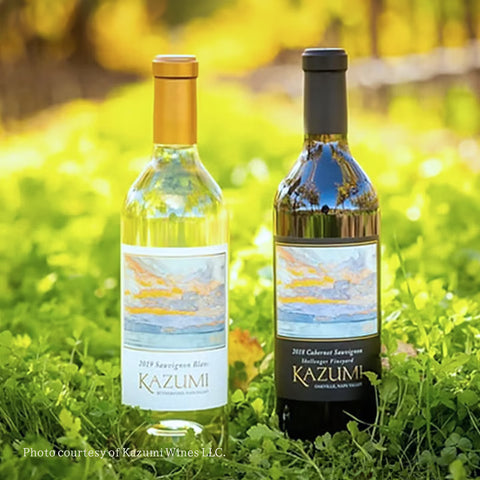
As one of the few places to find these wines outside the winery itself, we're proud to carry Kazumi's Napa Valley Koshu and Cabernet Sauvignon — each made in tiny quantities every year.
Meet Michelle Kazumi Sakazaki

Born in California and raised in Tokyo, Michelle Kazumi Sakazaki came to wine by way of fashion — studying design and working for Missoni and Armani in Milan and New York.
She went on to earn a WSET Diploma and an MBA, then spent twelve years as General Manager of Napa's 90 Plus Wine Club, learning the valley inside out before founding Kazumi Wines in 2015.
The name is her own — 和美, the characters for harmony (和) and beauty (美). Her touch is on every bottle, quite literally: Michelle hand-paints the watercolor labels herself.
A Japanese Grape, Reborn in Napa
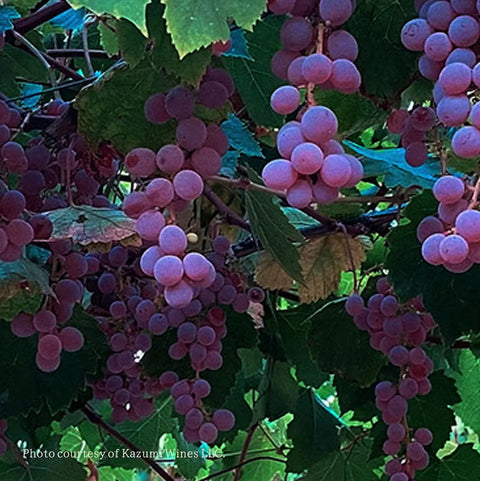
Koshu — a rare, pink-skinned grape — has been grown in Japan for over a thousand years, yet had never been cultivated commercially in the United States until Kazumi.
After the 2017 wildfires destroyed the family's vineyard, a friend offered Koshu cuttings from UC Davis. Michelle, her father Jack, and winemaker Kale Anderson planted a test plot — and it thrived.
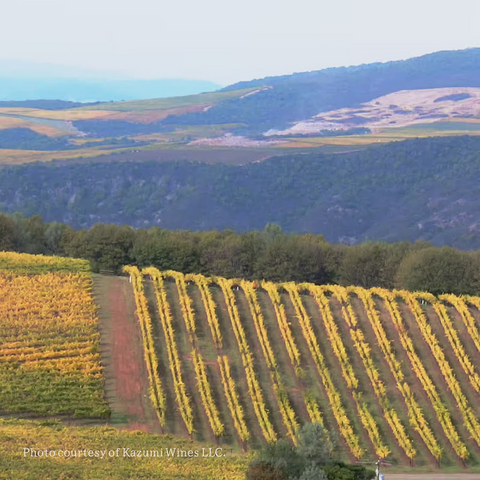
Those rows are now the only commercial Koshu vineyard in America, yielding the Napa Valley Koshu — white florals, citrus, and saline minerality — alongside a deeply structured Cabernet Sauvignon.
IN THE PRESS




A Timeline infographic from a whildfire to a first in America
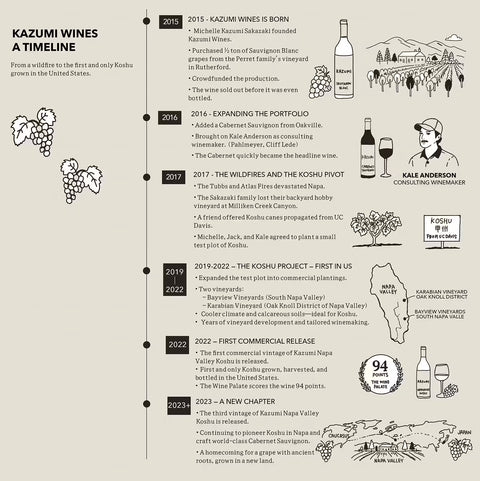
Kazumi's story is one of resilience and quiet pioneering: a decade-long journey from a half-ton of crowdfunded Sauvignon Blanc to the first Koshu ever grown on American soil.
The timeline traces how a backyard loss in the 2017 fires became one of Napa's most original wines — a homecoming for a grape with ancient roots, grown in a new land.
