

Introducing NORIA Wines: The California Wine Served in ANA First Class
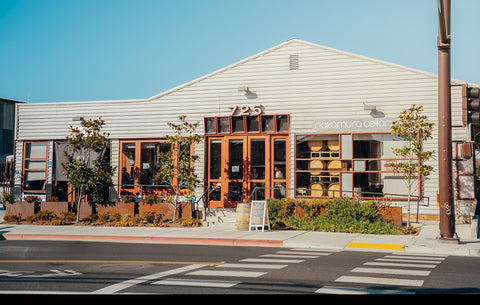
Table of contents
Introduction
I have something exciting I want to share with you.
We are so honored that we have now partnered with NORIA Wines, and you can order their excellent wines at Japanese Wine Co.!
NORIA is a winery in Berkeley, California, run by a Japanese winemaker, Nori Nakamura-san (中村倫久), together with his partner Atsushi Yanai-san (栁内淳). They make California wine with Japanese food in mind, and two of their wines were chosen by ANA for First Class on international flights.
I didn't want to just add new bottles to the shop and walk away. Nori-san's story matters too much for that, so I figured I'd actually sit down and write about who they are and how we got to know them.
(You may be wondering why a wine from California is in a shop called Japanese Wine Co. I asked myself the same thing, and I will come back to it near the end.)
How We Met NORIA
Miki and I visited their tasting room in Berkeley in June last year.

Miki in front of the winery. The sign says Nakamura Cellars, which is the company behind NORIA.
It is not in wine country at all! It's on a regular city street, and you can see the barrels through the big windows from the sidewalk. There was a chalkboard outside that said "WINE Tasting" with ワイン written under it in katakana, and that made us smile before we even walked in.

We sat down at the bar right next to the barrels and tasted quite a few of their wines that day. The one I could not forget was the Sauvignon Blanc.

I think you can tell how much Miki liked it. (^^)
They also had printed copies of a few articles about NORIA on the table, from Food & Wine and Wine Enthusiast. I took photos of every page so I could read them again at home, and some of what I am sharing below comes from those pages.


A few months later I opened a bottle of it and wrote "100!" in my wine notes, and I don't give that score very often.
So this September, I finally emailed them to ask if we could carry their wines.
I didn't know it at the time, but September is crush season, which is the busiest time of the year for a winery. Atsushi-san still wrote back the very next day and told me they would love to work with us.
So nice of him!
Then he sent a box of their wines to our home so we could taste them properly. Everything was so good that it was really hard for us to decide where to start. (If I'm being honest, I wanted all of them.)
Atsushi-san, Nori-san, thank you so much for being so kind to us from the very first email.
Who Is Nori Nakamura-san?

Nori Nakamura-san in the NORIA tasting room. Photo courtesy of NORIA Wines.
I have not heard the whole story from Nori-san himself yet, so most of what I am sharing here comes from NORIA's own website and from interviews he gave when the winery opened.
Nori-san was born and raised in Tokyo, and he did not grow up drinking wine. His first wine memory seems to be his uncle's Italian restaurant in Tokyo, where the whole family got together once or twice a year.
"Everybody sat at a long table, maybe 15 people, having a good time, eating good food," he told East Bay Magazine.
When he was 22, he went to Italy with his brother on a graduation trip, and he had a glass of aged Barbaresco at a trattoria in Milan. He calls it his first "goosebump moment." (I love that phrase!)
According to Food & Wine, he first wanted a career in cooking. He joined a Japanese hotel group because a big hotel has five or six restaurants, but he ended up in the sales department and not in the kitchen. So he went to sommelier school at night, and he earned his certification from the Japan Sommelier Association.
Then in 1999, his hotel company sent him to San Francisco for what was supposed to be two years. The funny part is that he was not interested in California wine at first. "The first three months I just avoided it," he told Food & Wine.
A friend took him to Napa, and a glass of Chardonnay there changed how he saw California wine. He told Berkeleyside, "I thought, 'Oh my God, shame on me. I really need to study and drink more California wine.'"
And he really did study. He visited 170 wineries in one year!
(I thought I was serious about wine, but I have not visited 170 wineries in my whole life.)
When it was time to move back to Japan, he resigned from his job and stayed. He went to UC Davis to study winemaking, started at the bottom as a "cellar rat," and worked his way up to assistant winemaker at Artesa in Napa and then head winemaker at Jamieson Ranch and Larson Family Winery.
In 2010, he started his own label while still working full time. From what I read, the first year was 300 cases, and all of it was sold in Japan.
There is a line in the Food & Wine article that I keep thinking about. He said that when he started at UC Davis, he still planned to get some experience in California and then move to Europe. "But now my perspective has completely changed. I don't want to go anywhere. I want to make better wine every year, and California gives me the biggest opportunity to do so."
He named it NORIA. It is "Nori" with an "a," and it is also the Spanish word for a waterwheel, which is the design you see on the label.
California Wine Made for Japanese Food

"I respect Japanese food culture so much," Nori-san told Food & Wine. "Once you move out of Japan, you realize how special it is."
I have lived in the US for a long time, and I feel exactly the same way.
This is the part that made me want to work with NORIA. Nori-san thinks about the food first. He told the San Francisco Chronicle that he has a style in mind before anything else, and then he looks for the right vineyard and the right grapes to make it.
And for his white wines, the model he has in mind is sake. His Chardonnay follows junmai ginjo (純米吟醸), which is apparently his favorite kind of sake to drink, so it has some richness but still finishes clean. He described that kind of sake to Wine Enthusiast like this: "It's round, almost sweet, big and bold, but with that backbone of nice acidity, that's the model for my Chardonnay."
(His Sauvignon Blanc, the one I gave 100, is modeled on daiginjo (大吟醸), which is a softer and fruitier style. We don't carry it yet, but I am hoping!)
He was careful to explain that he is not trying to make wine taste like sake. In his words, "It's not the taste but the structure and mouthfeel."
There is one more thing he said that I really liked.
"When I talk about Japanese food with non-Japanese people, some of them think that sushi is the only Japanese food. But there's a range of dishes, many different vegetables and appetizers, so many ingredients combined with different cooking techniques."
I could not agree more! Japanese home cooking has so many gentle flavors, and I think that is exactly why his wines are made the way they are.
Nori-san works with grape growers he has known for many years, and both the Pinot Noir and the Chardonnay we carry come from the Sangiacomo family in Sonoma, who he has worked with since his very first vintage.
Nori-san and Atsushi-san

Photo courtesy of NORIA Wines.
In 2023, Nori-san and Atsushi-san opened their own winery and tasting room in Berkeley. They call it California's only Japanese urban winery, and I think that is so cool!
The two of them were teammates on their college tennis team. About 30 years later, Atsushi-san was in the Bay Area with a business background, and they decided to build the winery together. Isn't that a great story?
They turned a building on Gilman Street into the winery. On the day of the first crush in his own winery, Nori-san told Berkeleyside, "I'm so scared. It feels good, but not quite yet."
I really like how honest that is, and it made me respect him even more.
Atsushi-san is the one I have been communicating with, and he even called me so we could talk directly, which made me very happy. He also shared the beautiful harvest photos you see in this article. They were taken by their friend Hiro-san of Hiro Sogi Media.
Hiro-san, thank you for the wonderful photos! (^^)
The Three Wines We Carry
As I mentioned, it was hard to choose. In the end we decided to start with three wines, and I hope we can add more later.
Please note that the tasting words below are mostly NORIA's own, since they describe their wines much better than I can.
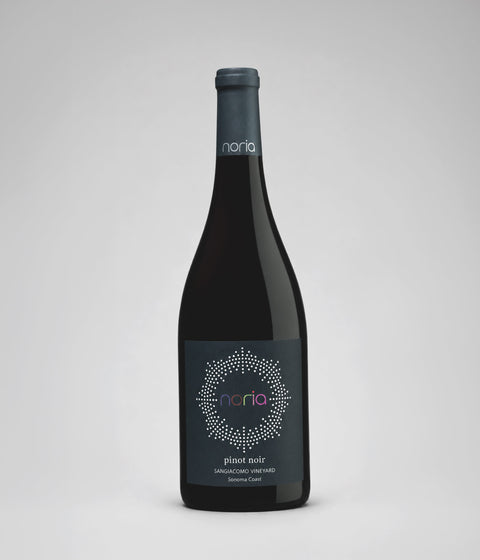
NORIA Sonoma Coast Pinot Noir

NORIA makes four different Pinot Noirs, so I asked Atsushi-san which one we should start with. The Sonoma Coast Pinot Noir was the first one he named, and it is one of the two wines ANA chose for First Class.
The grapes come from the Sangiacomo family's Roberts Road vineyard, which is in a cool and foggy area called the Petaluma Gap. NORIA describes the wine with raspberry, cherry and rose petal, and they call it "sensual and transparent." It is not a big, heavy red, so I think it should go nicely with soy sauce and dashi flavors.
Wine Enthusiast wrote that Nori-san picks his Pinot Noir grapes on the earlier side and is careful with oak, and that he ferments some of the grapes as whole clusters, which gives the wine black tea and nori notes. A red wine with a nori note! I had to read that twice.
NORIA Sonoma Coast Chardonnay

The Sonoma Coast Chardonnay is the wine Nori-san models on junmai ginjo sake, and it is the other wine ANA chose for First Class.
The grapes are from Green Acres, which I read is the very first vineyard the Sangiacomo family planted, back in 1969. NORIA's notes mention apricot, lime, golden apple and honeysuckle, with a little honey at the end.
If you usually skip Chardonnay because it feels too buttery or too oaky, I would love for you to try this one, because it is made in a very different way!
NORIA Sonoma Coast Rosé

The Sonoma Coast Rosé has my favorite story of the three. Nori-san first made it as a gift for his mother!
According to NORIA, it is still a limited production, and I read that for a while you could only buy it at the tasting room. (Except from our site now, thank you, Atsushi-san!) When I asked Atsushi-san what grape it is made from, he wrote back the next morning to tell me it is 100% Pinot Noir.
It has raspberry, strawberry and a hint of rose petal, and it is the gentlest of the three. I think it is the easiest one to open on a regular weeknight.
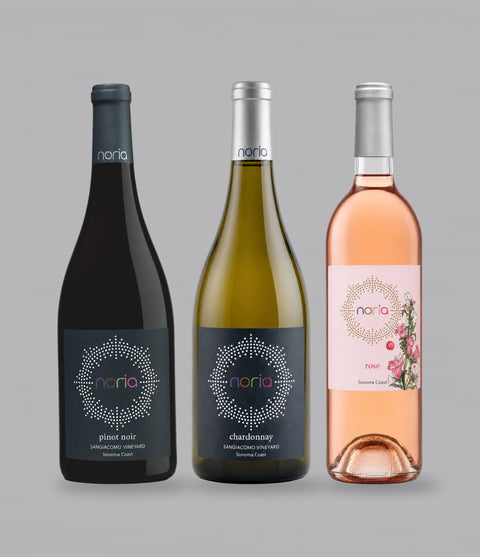
And if you cannot decide (like me), we also put all three together as the NORIA Sonoma Coast Combination Set.
Served in ANA First Class

In August 2024, ANA announced its new in-flight wine list, and both the NORIA Pinot Noir and the NORIA Chardonnay were selected for First Class on international flights, served on board from December 2024.

The two NORIA wines ANA chose for First Class: the Pinot Noir and the Chardonnay.
I was so happy when I learned this. Congratulations, Nori-san and Atsushi-san!
The wines have also done well with critics and at competitions.
- Wine Enthusiast gave the 2022 Pinot Noir 94 points and named it a Cellar Selection.
- Wine Enthusiast gave the 2022 Chardonnay 92 points.
- The 2019 Pinot Noir won Double Gold at the San Francisco Chronicle Wine Competition in 2022.
- The 2022 Chardonnay won Gold at the same competition in 2024.
We put everything together, with links, on our NORIA press page.
What to Eat with NORIA
When we tasted the wines at home, I wrote down the dishes that came to my mind for each one. I am sharing my notes as they are, so please take them as ideas and not as rules. (^^)

For the Pinot Noir, the first thing I wrote was tofu hambāgu (豆腐ハンバーグ), the Japanese hamburger steak made lighter with tofu. NORIA also suggests sukiyaki, roasted duck and pork. Please serve the wine a little cool, around 55 to 60 °F (13 to 16 °C). About 20 minutes in the fridge is enough.
For the Chardonnay, I wrote "summer corn" and "butter-yaki" (バター焼き), which means anything cooked in a pan with butter and a little soy sauce. Corn, scallops and mushrooms are all good this way. NORIA suggests yakitori and grilled shellfish, and Nori-san has said he likes it with egg dishes too. Please don't serve it ice cold. If you take it out of the fridge about 15 minutes before pouring, it should be around 50 to 55 °F (10 to 13 °C).
For the Rosé, my notes say sushi with gari (ガリ, the pickled ginger), saba (鯖, mackerel) and mentaiko (明太子) pasta. I think the pink wine with the pink ginger and the pink pasta is fun on the table too! You can chill this one well, around 45 to 50 °F (7 to 10 °C).
(One more thing. The San Francisco Chronicle article says these wines are also "pretty good with Italian tomato sauce," so you are covered on pasta night as well.)
Three Easy Dishes to Try
If you want to try my pairings at home, these are simple versions of the three dishes. Each one is for two people.
Tofu Hambāgu for the Pinot Noir

- 200 g (7 oz) ground beef and pork mix (or all beef)
- 150 g (5.3 oz) firm tofu, drained well
- 1/4 onion, finely chopped
- 3 tablespoons panko, 1 egg, a pinch of salt and pepper
- Sauce: 2 tablespoons soy sauce, 2 tablespoons mirin, 1 tablespoon sake, 1 teaspoon sugar
Wrap the tofu in paper towels and put a plate on top for about 15 minutes, so the water comes out. If you skip this, the patties can get too soft to flip.
Mix everything except the sauce by hand until it gets sticky, then shape it into two oval patties. Cook them in a little oil over medium heat for about 4 minutes on each side, with a lid on for the second side.
Pour in the sauce and let it simmer for a minute or two until it gets glossy. Grated daikon on top is very nice if you have it.
Corn Butter-Yaki for the Chardonnay

- 2 ears of fresh corn (or about 300 g / 10.5 oz of frozen corn)
- 15 g (1 tablespoon) butter
- 2 teaspoons soy sauce
- Black pepper
Cut the corn off the cob. Melt the butter in a pan over medium-high heat, add the corn, and please try not to stir it too much, because you want some of the kernels to get a little brown.
After 4 to 5 minutes, pour the soy sauce around the edge of the pan so it sizzles, mix it quickly, and finish with black pepper. That's it! You can do the same thing with scallops or shimeji mushrooms.
Mentaiko Pasta for the Rosé

- 200 g (7 oz) spaghetti
- 60 g (2 oz) mentaiko (spicy cod roe), taken out of its skin
- 20 g (1.5 tablespoons) butter, softened
- 1 teaspoon soy sauce
- Shredded nori and shiso leaves for the top
Mix the mentaiko, butter and soy sauce in a large bowl while the pasta cooks. You don't need to cook the sauce at all.
Put the hot pasta into the bowl with 2 to 3 tablespoons of the pasta water and toss it quickly. Top it with nori and shiso. If you can't find mentaiko, you can use tarako (plain cod roe) and add a little chili.
I have not tried every combination with every wine yet, so if you find a good one, please let me know! I want to try it too.
The NORIA Story in One Picture
We also made a timeline of the NORIA story for our NORIA winery page. I hope it makes the story easy to follow!

Is NORIA a Japanese Wine?
Now, back to the question from the beginning.
When we started Japanese Wine Co., we carried two wineries. Grace Wine makes Koshu (甲州) in Yamanashi (山梨), Japan, and Kazumi Wines grows Koshu in Napa. NORIA is different from both, because there is no Japanese grape here. It is Pinot Noir and Chardonnay grown in Sonoma.

All seven wines we carry now, from Grace, Kazumi and NORIA.
So it is not "Japanese wine" in the strict sense, and I thought about this for a while.
But when I told Nori-san and Atsushi-san about our shop, I wrote that I did not want every winery we carry to be the same kind. I want Japanese Wine Co. to have some range, with wines that each have their own personality. Nori-san is a winemaker from Tokyo who has spent more than 15 years making wine for Japanese food, and I am proud to have his wines next to Grace and Kazumi.
And honestly, it is also very simple. We tasted the wines, and we wanted to share them with you.
Quick Reference
| Wine | Vintage | Notes | Price |
|---|---|---|---|
| NORIA Sonoma Coast Pinot Noir | 2024 | Sangiacomo Roberts Road Vineyard. 14.1% ABV. Selected for ANA First Class. | $52 |
| NORIA Sonoma Coast Chardonnay | 2025 | Sangiacomo Green Acres Vineyard. 14.1% ABV. Selected for ANA First Class. | $40 |
| NORIA Sonoma Coast Rosé | 2025 | 100% Pinot Noir. 14.1% ABV. Limited production. | $35 |
| NORIA Sonoma Coast Combination Set | 2024 / 2025 | One bottle each of the three wines above. | $127 |
All bottles are 750 ml. For now, we can ship wine to California and Washington, DC.
Conclusion
Nori-san, Atsushi-san, thank you so, so much for trusting us with your wines!
We are so honored to carry NORIA, and I am very happy that what started with a visit to your tasting room turned into this.
If you try one bottle, I would start with the Pinot Noir and open it with something Japanese for dinner. Then please tell me what you ate with it!
Any questions about NORIA, or about anything we carry, please don't hesitate to reach out to us. We love talking about this stuff.
Thanks for reading. (^^)
Try NORIA at home


Subscribe to the Japanese Wine Club
Sign up for free to the Japanese Wine Club to get advice, exclusive articles, tips, and special offers.

About the author

Subscribe to the Japanese Wine Club
Sign up for free to the Japanese Wine Club to get advice, exclusive articles, tips, and special offers.
Comments (0)
There are no comments for this article. Be the first one to leave a message!